
Planning
How many grafts do I actually need?
Graft counts are the first thing patients ask about and the last thing that can be answered honestly online. The number depends on four measurable things — and on one that no calculator can see.
7 min readReviewed by the Azrak Hair clinical teamUpdated 2026
A graft is not a hair
The single most common misunderstanding in hair restoration is the difference between a graft and a hair. A graft is a follicular unit — the natural cluster in which hair grows out of the scalp. Depending on genetics and on the region of the donor area, a follicular unit contains one, two, three, occasionally four hairs. The working average sits somewhere between 2.1 and 2.4 hairs per graft.
That means a 3,000 graft procedure moves roughly 6,500 to 7,000 individual hairs. It also means two patients quoted the same graft number can end up with visibly different density, because one of them is carrying more hairs inside each unit. When a clinic advertises a number, always ask whether it is grafts or hairs. Quoting hairs makes a package sound twice as generous as it is.
The four measurable variables
A surgeon planning a case is doing arithmetic on four inputs, all of which can be measured in a consultation room in about fifteen minutes.
- Area to be covered, in square centimeters. The front third of a scalp is roughly 50 cm². A full top including the crown can exceed 200 cm². Area scales the whole calculation.
- Target density, in follicular units per cm². Native, untouched scalp runs about 80–100 FU/cm². Transplanted density is typically planned at 35–50 FU/cm², because a well-angled 40 that is fully perfused looks better than a crowded 60 where a third of the grafts fail.
- Donor supply. The safe donor zone at the back and sides holds a finite lifetime budget, commonly estimated at 5,000–8,000 grafts across all sessions for an average scalp. Extract past that and the donor itself starts to look thin.
- Contrast between hair and skin. Dark, coarse hair on pale skin needs more grafts to read as full than fine, light hair on similar-toned skin. This is why hair caliber often matters more than hair count.
Rough ranges by Norwood stage
These ranges are planning figures used across the field, not a quote. They assume a single session, an average donor area, and coverage rather than teenage density as the goal.
| Stage | Typical area | Planning range |
|---|---|---|
| Norwood II | Temple corners only | 800 – 1,500 grafts |
| Norwood III | Hairline + temples | 1,500 – 2,500 grafts |
| Norwood III vertex | Hairline + early crown | 2,000 – 3,000 grafts |
| Norwood IV | Front third + crown | 2,500 – 3,500 grafts |
| Norwood V | Front + mid + crown | 3,000 – 4,500 grafts |
| Norwood VI – VII | Large area, limited donor | 4,500 – 6,000+, usually staged |
The variable no calculator can see
The fifth input is future loss. A transplant does not stop androgenetic alopecia; it relocates hair that is resistant to it. If a 26-year-old at Norwood III spends 2,800 grafts on a low, dense hairline, and the pattern advances to Norwood V by 40, he is left with an island of transplanted hair in front of a bald mid-scalp and no donor left to fix it.
This is why an experienced surgeon will sometimes recommend fewer grafts than a patient wants, or a higher hairline than a patient asks for, or no surgery at all this year. A plan that looks good at 30 and absurd at 45 is a failed plan, even if every graft grew.
It is also why medical therapy is discussed before surgery is scheduled. Stabilizing native hair with finasteride or minoxidil changes the arithmetic — it protects the hair between the transplanted zone and the crown, which is the hair that makes a result look continuous.
Why megasessions are not automatically better
Clinics advertising 5,000 or 6,000 grafts in one day are describing an endurance event as though it were a feature. Very large sessions have real trade-offs: extraction fatigue raises transection rates, grafts spend longer outside the body, and the recipient area's blood supply has to feed an enormous number of new tissue implants at once.
There are legitimate reasons to run a large session — a big area with a strong donor, or a patient who cannot travel twice. But the decision should be surgical, not commercial. A staged plan of 3,000 now and 2,000 in eighteen months often yields a better-looking, more durable result than 5,000 crammed into a single fourteen-hour day.
What to bring to a consultation
Photographs of yourself at 18 to 22 tell a surgeon how far your hairline has already traveled. A family history — father, grandfathers, maternal uncles — tells them where it is likely to go. A list of medications, thyroid results if you have them, and an honest account of any rapid recent shedding all change the plan.
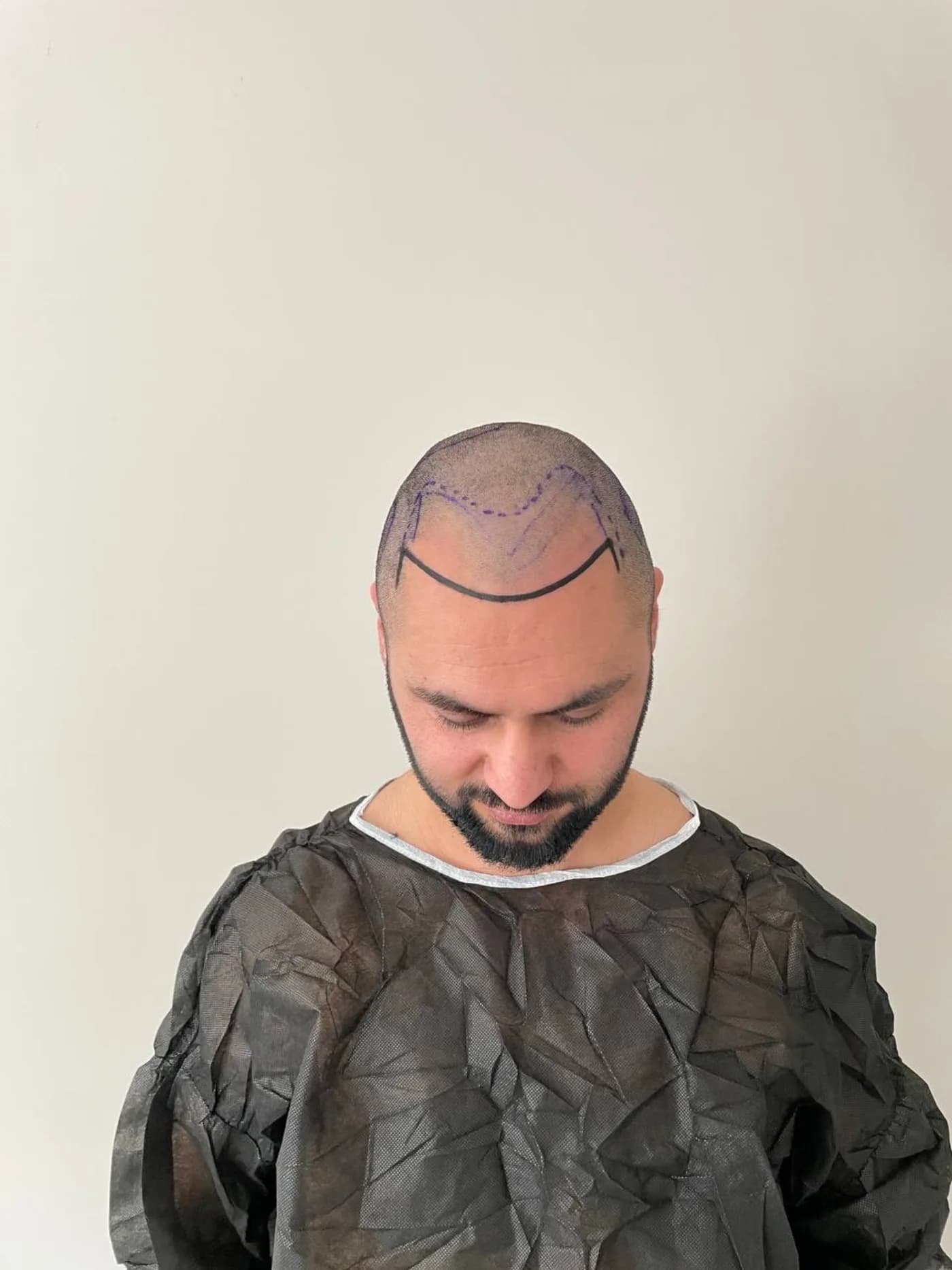
You should leave the consultation with three things: a graft range rather than a single number, a drawn hairline you have seen on your own head in a mirror, and a clear statement about what is not being covered in this session and why.
Frequently asked questions
- Can I get an exact graft number online?
- You can get a range. An exact number requires measuring donor density and mapping the recipient area in person, because the two together set the ceiling on what is possible.
- Is more grafts always better?
- No. Donor supply is finite and unrenewable. The right number is the smallest one that achieves the visual goal, because whatever is left in the donor area is what funds the next twenty years of loss.
- What if my donor area is weak?
- Then the plan changes: a smaller covered area, a higher hairline, body hair as a supplementary source in selected cases, or a recommendation against surgery. Weak donor is the single most common honest reason to decline a case.
This article is general information about hair transplantation, not medical advice about your case. Whether any procedure or medication is right for you can only be decided after an examination. Read the full medical disclaimer.
Find out what is really possible with your donor area.
A free assessment, an honest graft count and a clear answer on whether surgery is the right move right now.