

Hair loss
Male Pattern Hair Loss
Male pattern loss follows a predictable route: temples first, then the crown, then the two meet. Knowing where you are on that route is what decides whether you should be operating, medicating, or waiting.
- Affects
- ~50% of men by age 50
- Cause
- DHT sensitivity, inherited
- Onset
- Commonly early 20s to 30s
- Progression
- Decades, in steps
What is actually happening
Androgenetic alopecia is not hair falling out so much as hair getting smaller. Follicles on the top of the scalp are genetically sensitive to dihydrotestosterone. Each growth cycle they produce a slightly finer, shorter, lighter hair — a process called miniaturization — until what is left is a colorless vellus hair that gives no coverage at all.
The follicles at the back and sides do not carry that sensitivity. That is the entire basis of hair transplantation: move a DHT-resistant follicle to the top and it keeps its resistance.
The pattern is predictable, which is useful
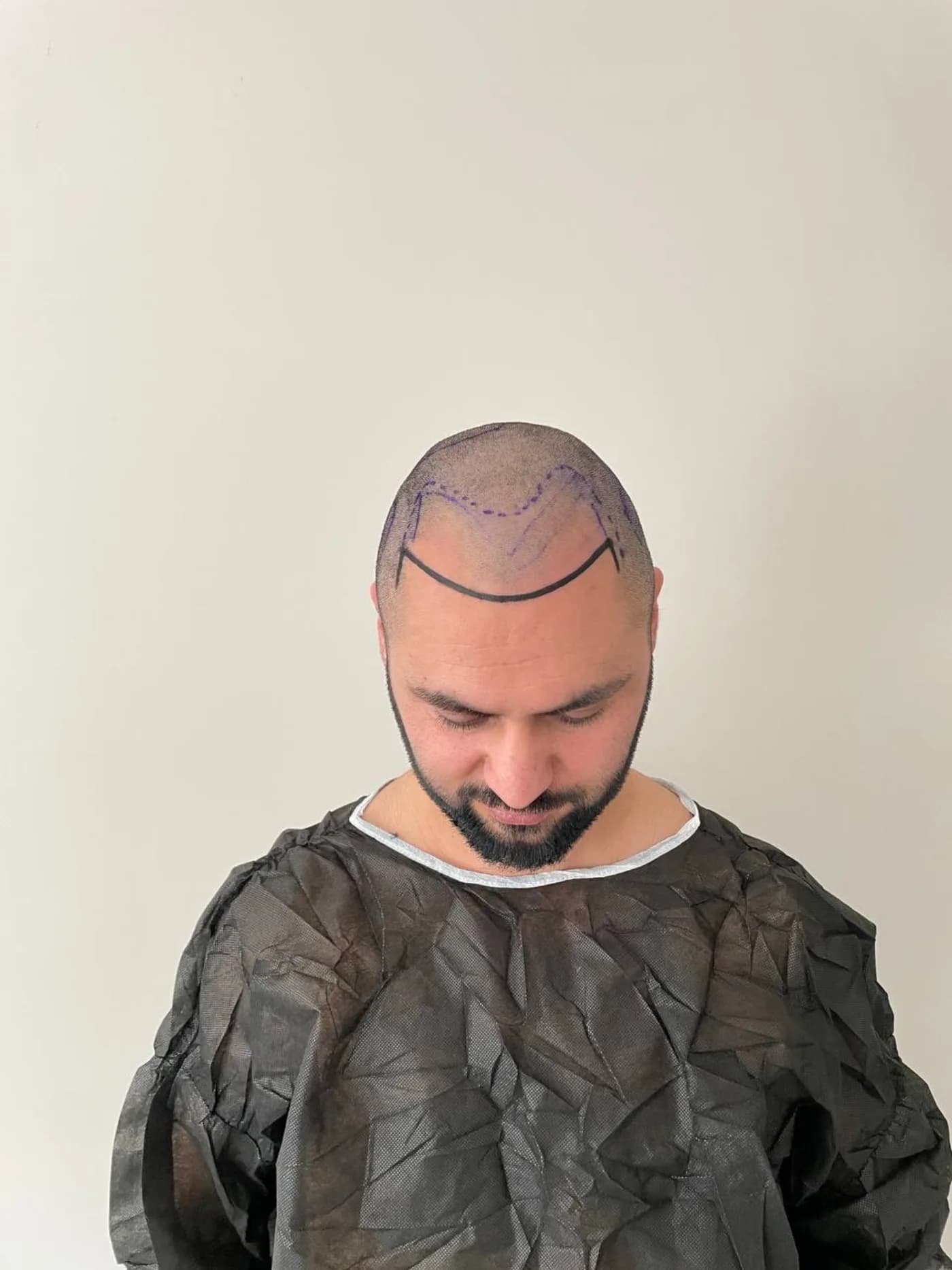
Loss almost always starts at the temples and the frontal hairline, then the crown. In between there is often a bridge of surviving hair that thins last. Because the sequence is consistent, a surgeon can predict roughly where you will be in ten years — and design a hairline that will still look right when you get there.
That prediction is why age matters so much. A 22-year-old at stage II may be a stage V at 40. Building him a dense, low hairline now spends donor hair he will desperately need later.
What stops it, and what does not
Two medications have real evidence behind them: finasteride, which blocks the conversion of testosterone to DHT, and minoxidil, which extends the growth phase. Neither regrows a dead follicle, and both stop working when you stop taking them. Both have side-effect profiles worth discussing with a physician rather than a forum.
PRP and mesotherapy can support miniaturizing follicles. Shampoos, supplements, laser combs and scalp massage do not reverse androgenetic loss, whatever the packaging says. If your loss is advancing and you are not on a medical therapy, surgery alone will leave you chasing the recession.
When surgery is the right answer
When the pattern has declared itself, the donor area is dense enough to fund the area you want covered, and expectations are for coverage rather than the density of a teenager. If any of those three is missing, the honest recommendation is to wait, to medicate, or to accept a smaller plan.
How to tell whether it is actually progressing
Memory is unreliable about hair. Almost every man who believes his loss accelerated this year is comparing today against a photograph in his head from an unspecified point in the past, taken in different light. The two measurements that mean something are photographic and physical.
Take standardized photographs — same room, same light, dry hair, four angles including the crown from above — every three months, and compare the series rather than your recollection. In clinic, the equivalent is trichoscopy: measuring the proportion of miniaturized hairs in a defined area. A scalp where more than a fifth of hairs are noticeably finer than their neighbours is actively miniaturizing, whatever the mirror suggests.
- Increased shedding in the shower for more than three months, rather than a seasonal few weeks.
- Scalp becoming visible under overhead light before it is visible in the bathroom mirror.
- Hair at the temples or crown that feels finer to the touch than hair at the back.
- A part line that has widened in photographs taken a year apart.
The timing problem, stated plainly
Male pattern loss is a moving target for two to three decades. That creates a genuine dilemma: operate early and you risk designing for a head that no longer exists at forty; wait too long and you spend years unhappy about something that was treatable.
The usual resolution is sequencing rather than choosing. Stabilize medically first, if you are willing, so that the rate of loss is known rather than assumed. Then operate on the area that does the most visual work — the front third frames the face and delivers most of the perceived improvement — while leaving donor supply in reserve for the crown, which consumes grafts at a punishing rate.
Under about twenty-five, the default advice is to wait unless the pattern is already advanced, because the final shape of the loss has not declared itself. That advice is unpopular and it is correct.
Find out what is really possible with your donor area.
A free assessment, an honest graft count and a clear answer on whether surgery is the right move right now.