
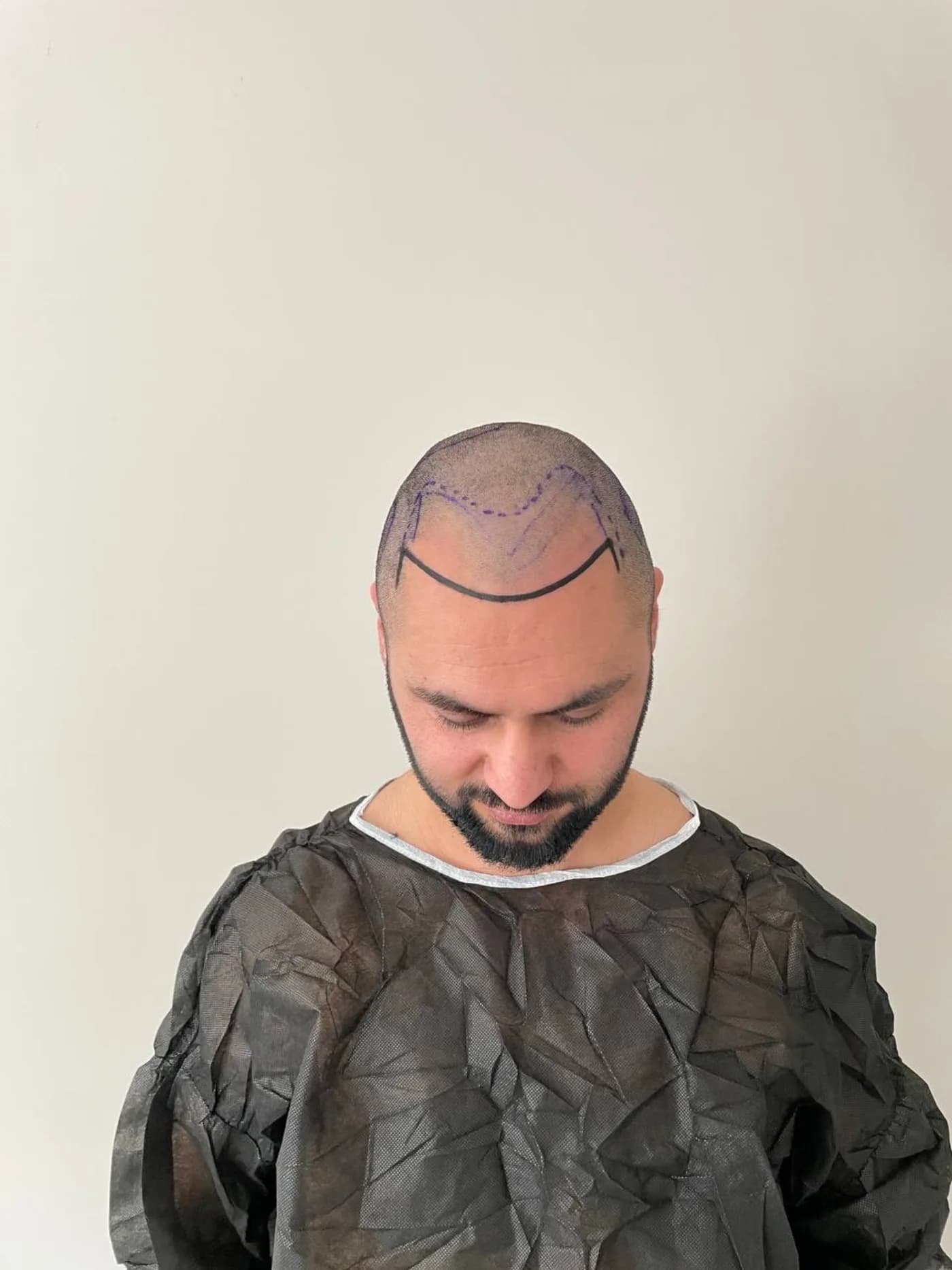
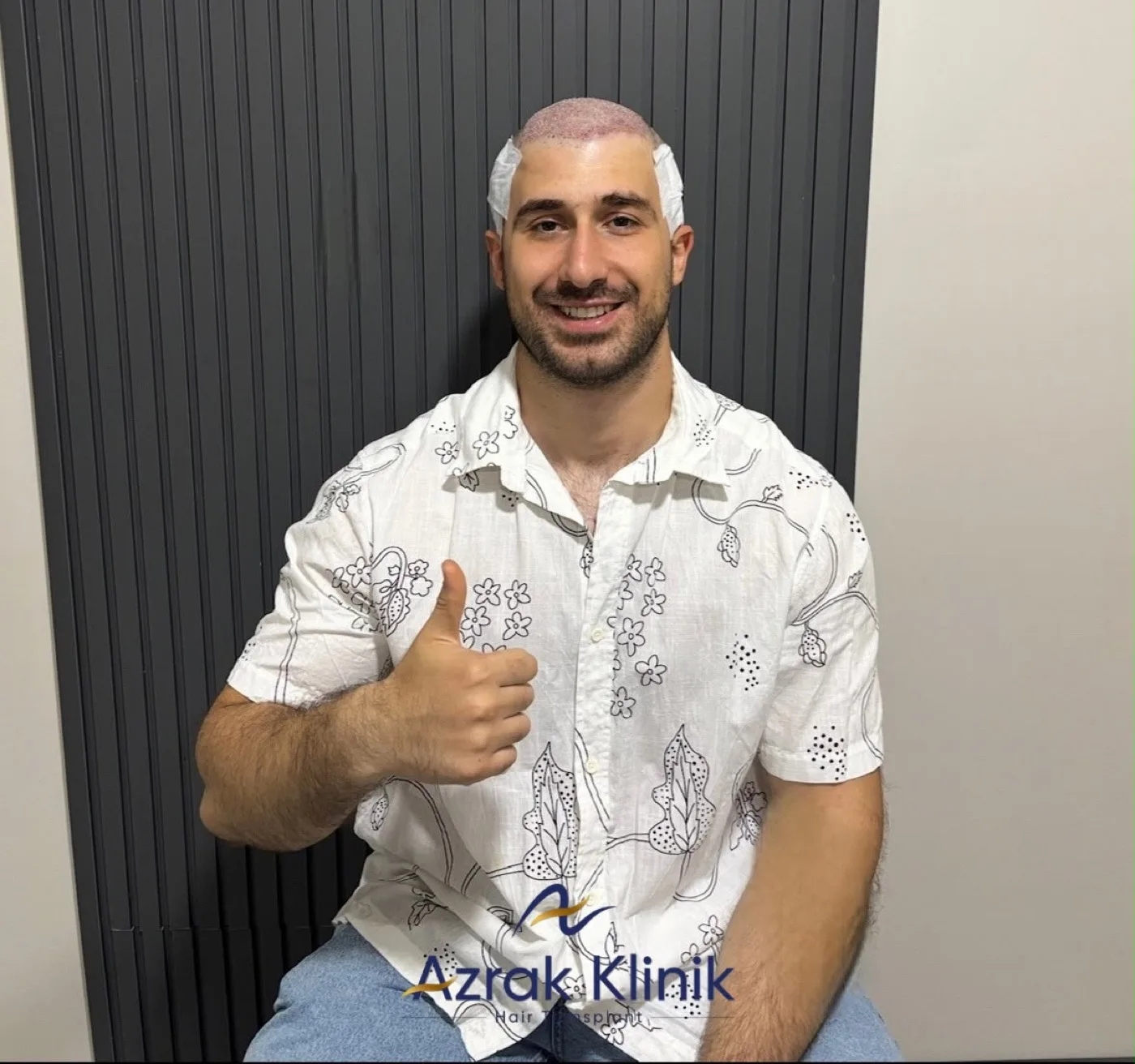
Recovery
The hair transplant timeline, month by month
Almost every patient who panics after a transplant panics in the same eight-week window, about the same thing, and for no reason. Here is the whole timeline, including the phase most clinics under-explain.
8 min readReviewed by the Azrak Hair clinical teamUpdated 2026
Days 0 to 3: the grafts are not yet yours
For the first seventy-two hours the transplanted follicular units are held in place by nothing more than a fibrin clot and the tight fit of the channel. They have no blood supply of their own yet — they are surviving on plasma diffusing from the surrounding tissue. This is the only period in the entire process where a graft can be physically lost, and it is lost by friction, not by bad luck.
That is the reason for every irritating instruction you are given: sleep at 45 degrees, do not let a pillow touch the recipient area, spray saline on schedule, no hats that pull, no bending, no lifting. Swelling of the forehead is common on days two to four as anesthetic fluid drains downward. It looks alarming, it is harmless, and it resolves.
Days 4 to 14: crusts, washing, and the first shock
Small crusts form around each graft. They are not scabs over a wound so much as dried plasma around a seated follicle, and they must come off gently, by softening rather than scrubbing, starting with the first supervised wash at the clinic the day after surgery. By day ten to fourteen most patients are clear of crusting.
The donor area behaves differently. Thousands of sub-millimetre punch sites close as tiny dots, typically sealing within seven to ten days, and being covered by surrounding hair long before they are invisible up close. Numbness or tightness at the back of the head can persist for weeks and occasionally months; it almost always resolves.
Most patients are presentable to strangers somewhere between day ten and day fourteen — presentable meaning short, even redness that reads as sunburn rather than surgery. Full public confidence usually comes later.
Weeks 3 to 8: shock loss, and why it is good news
Between the third and eighth week the transplanted hairs fall out. Not some of them — most of them. Patients who were not warned about this arrive at the clinic convinced the operation has failed.
It has not. The hair shaft is shed while the follicle beneath it, which is what was actually transplanted, enters a resting phase before restarting its cycle. Shedding is the expected behavior of a follicle that has survived relocation. What you paid for is under the skin, not on top of it.
Some patients also shed native hair around the recipient area in the same window — 'shock loss'. Miniaturized native hairs that were close to the end of their life are pushed into shedding by the trauma of surgery. Healthy native hair regrows; hairs that were already failing may not, which is one more reason medical therapy is discussed before surgery.
Months 3 to 6: the first growth
New hairs begin to push through, typically from month three to four, and they arrive fine, wispy and sometimes strangely curled or kinked. Caliber and texture normalize as the follicle completes full cycles. Growth is never uniform: the front usually leads, the crown almost always lags, and asymmetry between sides at month five is common and temporary.
By month six most patients have something they are pleased with in a mirror at conversational distance, and roughly half of the eventual density. Some ingrown hairs and small pimple-like folliculitis spots are common in this phase as new hairs break through; they are usually self-limiting and should be shown to the clinic rather than squeezed.
Months 6 to 12: density arrives
The second half of the year is when a transplant stops being a promise and becomes a haircut. Hairs thicken, the density gap closes, and styling options return. This is the period where before-and-after photographs are usually taken, and it is why a photograph labeled 'after' without a month attached to it is close to meaningless — a month-eight photograph and a month-fourteen photograph of the same head are visibly different.
Months 12 to 18: the final assessment
Frontal results are largely mature at twelve months. The crown, which has a spiral growth pattern and a slower cycle, often needs fifteen to eighteen months before it can be judged fairly. Any conversation about a touch-up session, a second pass for density, or a refinement of the hairline belongs at this point and not earlier.
A properly run aftercare program photographs the same angles in the same light at months one, three, six, twelve and eighteen. Without that series, both patient and surgeon are arguing from memory, and memory is unreliable about hair.
| Milestone | What you see | What is happening |
|---|---|---|
| Day 3 | Crusts, swelling | Grafts revascularizing |
| Day 14 | Crust-free, mild redness | Recipient skin healed |
| Week 3–8 | Transplanted hair sheds | Follicles entering rest |
| Month 3–4 | Fine new hairs | Growth phase restarts |
| Month 6 | ~50% of final density | Caliber thickening |
| Month 12 | Frontal result mature | Crown still developing |
| Month 18 | Final assessment | Touch-up decision point |
What can move the timeline
Smoking constricts the microvasculature that new grafts depend on and is associated with slower, patchier growth. Uncontrolled diabetes, significant iron or thyroid abnormalities, and severe stress all pull growth to the right. Age tends to slow the curve slightly. None of these makes a good result impossible, but all of them are worth correcting before surgery rather than after.
Frequently asked questions
- When is it safe to wear a hat?
- A loose, non-friction hat is usually permitted from around day ten, but ask your clinic — the answer depends on how your recipient area is healing, not on the calendar.
- Is it normal for one side to grow faster?
- Yes. Asymmetric growth between months four and eight is common and typically resolves. Persistent asymmetry at month twelve is worth reviewing.
- When can I go back to the gym?
- Light walking almost immediately; sweating, heavy lifting and anything that raises head pressure usually after two to four weeks. Contact sport waits longer.
This article is general information about hair transplantation, not medical advice about your case. Whether any procedure or medication is right for you can only be decided after an examination. Read the full medical disclaimer.
Find out what is really possible with your donor area.
A free assessment, an honest graft count and a clear answer on whether surgery is the right move right now.