
Questions
The answers, including the unflattering ones.
Hair transplantation is an industry with a marketing problem. Where an honest answer costs us something, we have given it anyway.
Where these answers come from
Everything below is either established clinical practice, a published planning convention used across the field, or a statement about how this clinic works. Where a question has a genuinely contested answer — the persistence of finasteride side effects, the strength of the evidence for exosomes — it is answered as contested rather than resolved in whichever direction sells better.
Some questions are missing on purpose. We do not publish an answer on the price of our procedure, because that number comes from an examination, not a price list. We do not publish success rates or graft survival percentages, because those are the easiest figures in this industry to inflate and the hardest for a patient to verify. If an answer would require a claim we cannot document, the question is left out rather than answered vaguely.
- Longer explanations of the topics below live in the guide section, one article per subject.
- Anything specific to your own case needs an examination — these answers are deliberately general.
- If your question is not here, the clinical team answers it directly within one business day.
Deciding
Three things decide it: how much you have lost, how dense your donor area is, and whether the loss has stabilized. A donor area that cannot fund the area you want covered is the most common reason we recommend against surgery — and we would rather tell you that at consultation than after you have paid a deposit.
Under 24 is usually too early, because the final pattern has not declared itself. Operate on a hairline at 21 and by 35 the native hair behind it has receded away, leaving a floating island of transplanted hair. Medical therapy first, surgery once the pattern is clear.
The honest answer is that nobody can tell you from a photograph alone. Planning ranges by pattern stage run from roughly 1,500 grafts for early recession to 5,500 or more for advanced loss — but donor density is what actually sets the ceiling, and that requires examination.
The procedure
The anesthetic injections sting for a few minutes. After that the scalp is numb and the operation is not painful. Most patients spend the day talking, eating, or watching something. Discomfort in the days afterwards is usually described as tightness rather than pain and is managed with simple analgesia.
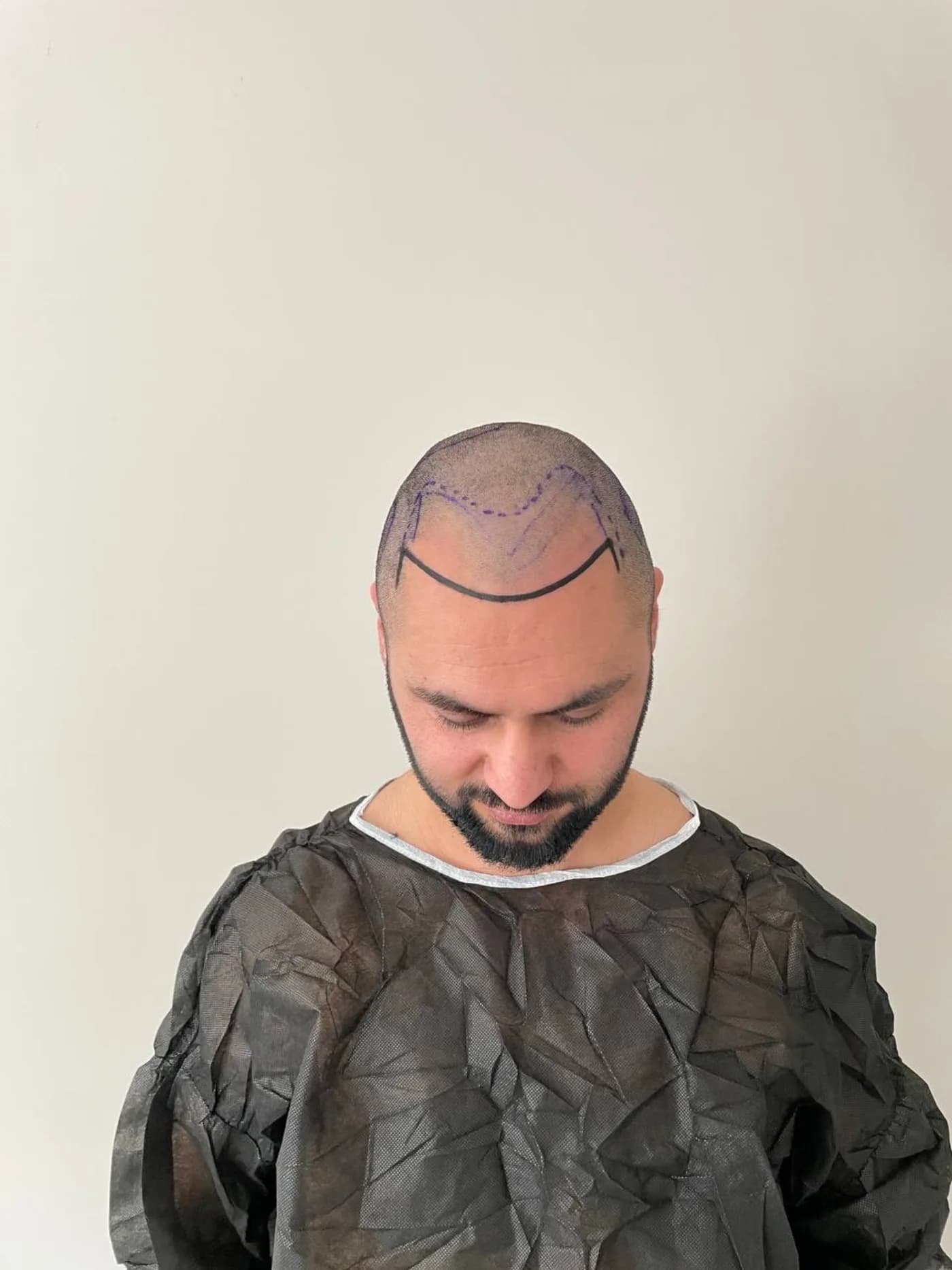
For a full-session FUE, the donor area is shaved. For DHI and for most female cases, the recipient area can be left unshaved. If shaving is genuinely not an option for you, ask about the unshaven technique — it works, at a lower graft ceiling and a higher cost per graft.
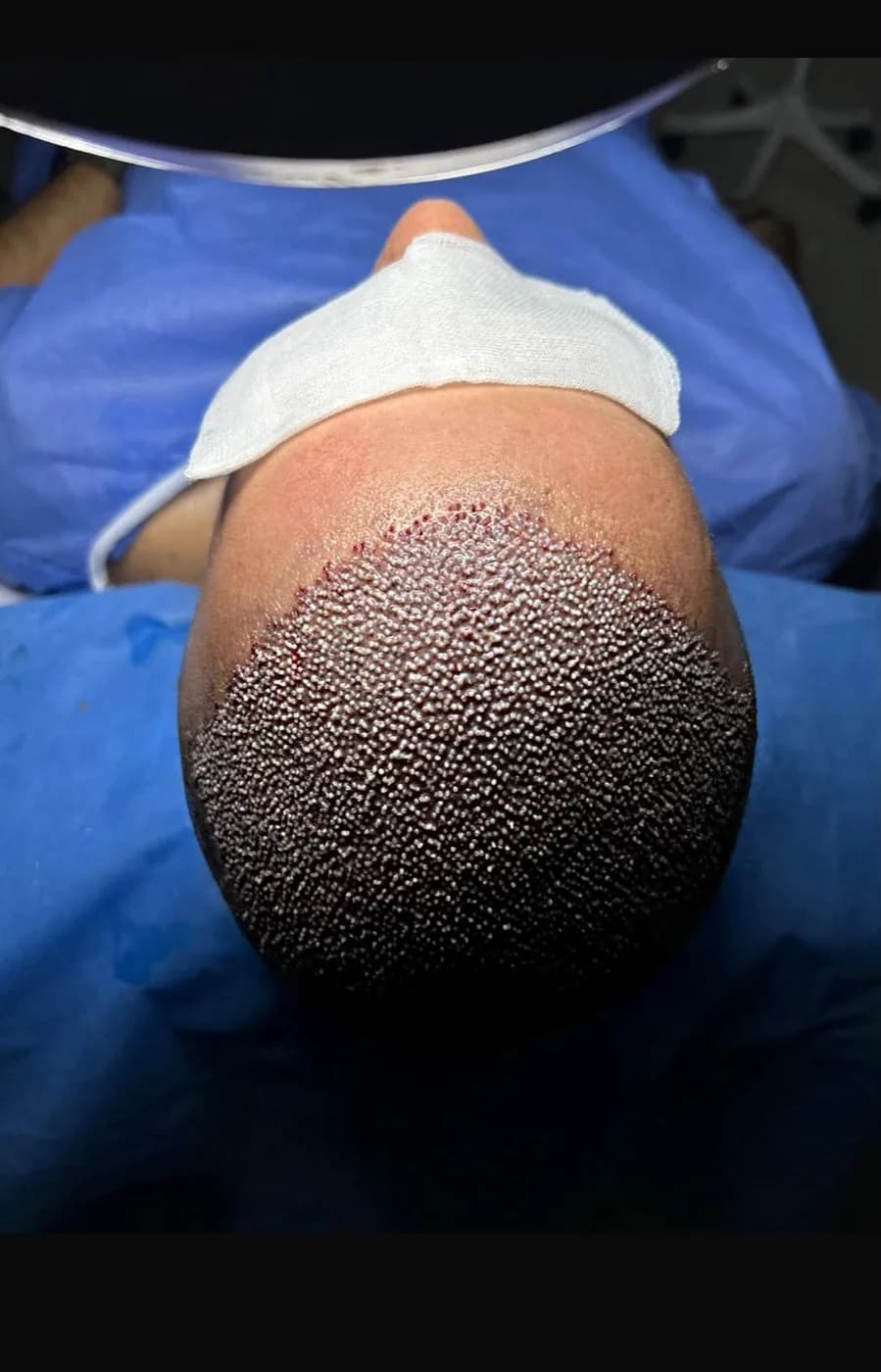
FUE leaves hundreds of dot-shaped marks under a millimeter wide, distributed so that no area is depleted. Once surrounding hair reaches a few millimeters they are not visible. The linear scar people worry about belongs to the older strip technique, which we do not perform.
A full session runs six to nine hours including breaks. You arrive in the morning and leave the same day. There is no overnight stay.
Recovery
Desk work: three to five days if you are comfortable with visible redness, ten to fourteen days if you would rather it had settled. Physical work and gym training: three weeks. Swimming, sauna and direct sun: four weeks.
No — this is shock shedding, and it happens to almost everyone between weeks two and six. The shaft is lost, the follicle stays and enters a resting phase before regrowing. It is the most alarming and the most predictable stage of the whole process.
New growth typically starts at month three or four. Visible coverage by month six. Thickening and maturing through months nine to twelve. Final assessment belongs at month twelve to eighteen — judging it earlier means judging an unfinished result.
Transplanted hair does not need medication to survive. Your remaining native hair might, if it is still receding. Whether that is right for you depends on your pattern, your age and your tolerance of side effects, and it is a conversation with the surgeon rather than a default prescription.
Traveling to Istanbul
Plan for three nights minimum: arrival and consultation, surgery day, and the first wash at the clinic the day after surgery. Four nights is more comfortable. Flying home the evening after surgery is possible but not what we recommend.
You receive direct contact with the clinical team for the full twelve months of aftercare, with photographic review at each stage. If a complication needs hands-on care, we coordinate with a physician where you live rather than asking you to come back to Istanbul.
Your question isn't on this page?
Ask it directly — the clinical team replies within one business day, free of charge and with no obligation.