
Surgical Hair Transplant
DHI Hair Transplant
In Direct Hair Implantation, each follicle is loaded into a hollow pen and implanted in one motion — no channels are opened in advance. Grafts spend less time outside the body, and the surgeon controls the angle graft by graft.
Channel and graft in a single motion with the Choi implanter.
- Duration
- 7–9 hours
- Anesthesia
- Local, optional sedation
- Graft range
- 1,500 – 4,000
- Back to work
- 10–14 days
- First growth
- Month 3–4
- Final result
- Month 12–18
What it actually is
In classic FUE, the surgeon opens all the channels first, then fills them. In DHI, the Choi implanter pen does both at once: the graft is preloaded into the needle, the needle enters the scalp, and a plunger releases the follicle at depth. One motion.
The advantage is time out of body. Every minute a follicle spends outside the scalp in holding solution is a minute it isn't being nourished. DHI narrows that window. It also gives the surgeon direct, graft-by-graft control over angle and depth — which is why it suits the hairline and any area that has to be worked between existing hairs.
The price is speed. DHI is slower per graft, so for very large sessions sapphire FUE — or a combination of both — usually works better: DHI at the hairline, where precision decides the result, and sapphire FUE behind it, where volume does.
Who it suits
- Hairline and frontal work where angle precision is decisive
- Adding density between existing hairs without shaving them
- Sessions of up to roughly 4,000 grafts
- Patients who want the least possible time between extraction and placement
When we say no
- Very large coverage needs of more than ~4,500 grafts in one session
- Very thick or coarse follicles that don't load cleanly into a Choi pen
- Budgets where a higher cost per graft is the deciding factor
These are general indications, not a diagnosis. Whether this procedure is right for you is decided by an examination, not by a website.
Step by step
What happens,
in order.
- 01
Hairline design
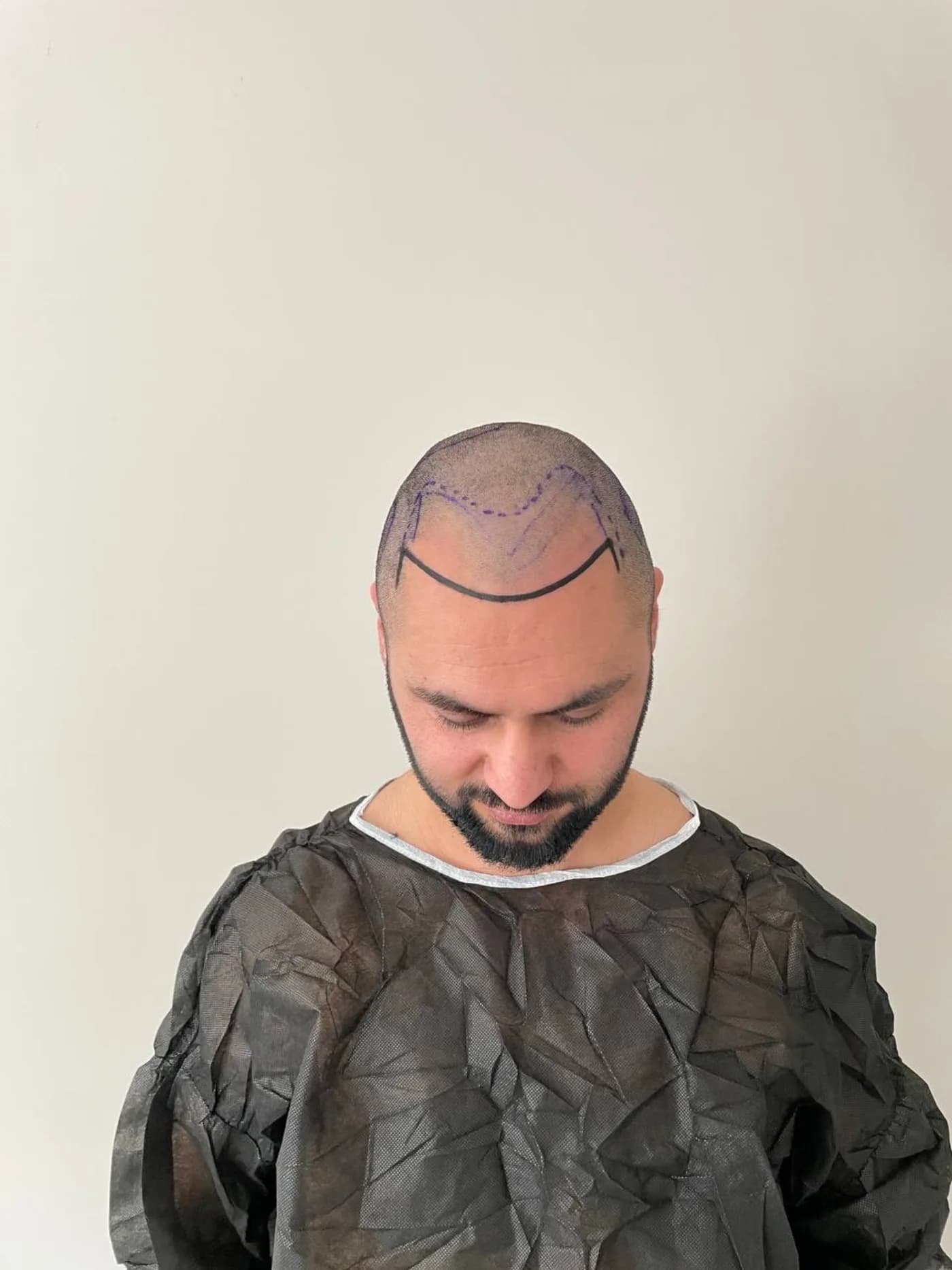
Mapped to your facial proportions and marked while you sit upright.
- 02
Local anesthesia
The donor and recipient areas are numbed gradually.
- 03
Extraction
Follicular units are removed one by one and sorted by hair count.
- 04
Loading
Each graft is loaded into a Choi implanter matched to its caliber.
- 05
Direct implantation
Channel and placement in a single motion; the angle is set separately for every graft.
- 06
First wash
At the clinic the day after surgery, with written aftercare instructions and your medication schedule.
Why the implanter changes the day, not the operation
A Choi implanter is a hollow needle with a plunger. The graft is loaded inside, the needle makes the incision and the plunger releases the follicle in one motion. Nothing changes in extraction; the donor area is worked exactly as in any FUE procedure, with the same punch and the same limits.
What changes is the recipient sequence. There's no field of open channels waiting to be filled; grafts spend less time out of the body, and placement can be threaded between existing hairs without needing to see a pre-made site. That's why DHI dominates unshaven work and is the usual choice for women, who often refuse shaving entirely.
The trade-off nobody advertises
Implanters are slower per graft, which makes DHI more expensive for the same count and impractical for very large areas in a single day. They also demand more of the team: loading a graft without crushing it takes practice, and in a technique where the same instrument both cuts and places, a tired hand in the ninth hour is a real variable.
The honest summary is this: DHI isn't a superior operation; it's a different implantation step with specific advantages. Where a plan needs precision at the front and volume behind, the two techniques are often combined in one procedure rather than choosing one or the other.
Not sure where you stand?
A free assessment gives you a measured graft range and a clear answer on whether surgery is the right move this year.
Get a free assessmentQuestions
Straight answers.
Neither, in the abstract. DHI wins on per-graft angle control and time out of body; sapphire FUE wins on volume in a single session. A serious clinic recommends one over the other based on your donor area and coverage needs, not because it prefers to sell it.
Partly. The recipient area can often be left unshaven — one of the reasons DHI is popular for adding density between existing hairs. The donor area normally still needs to be trimmed.
The number of wounds is similar. What changes is the sequence, not the trauma. Be wary of anyone who describes DHI as 'non-surgical' — it is surgery.
Is DHI the right procedure for you?
Send four answers and let the clinical team tell you — even if the answer is no.