
Surgical Hair Transplant
Unshaven Hair Transplant
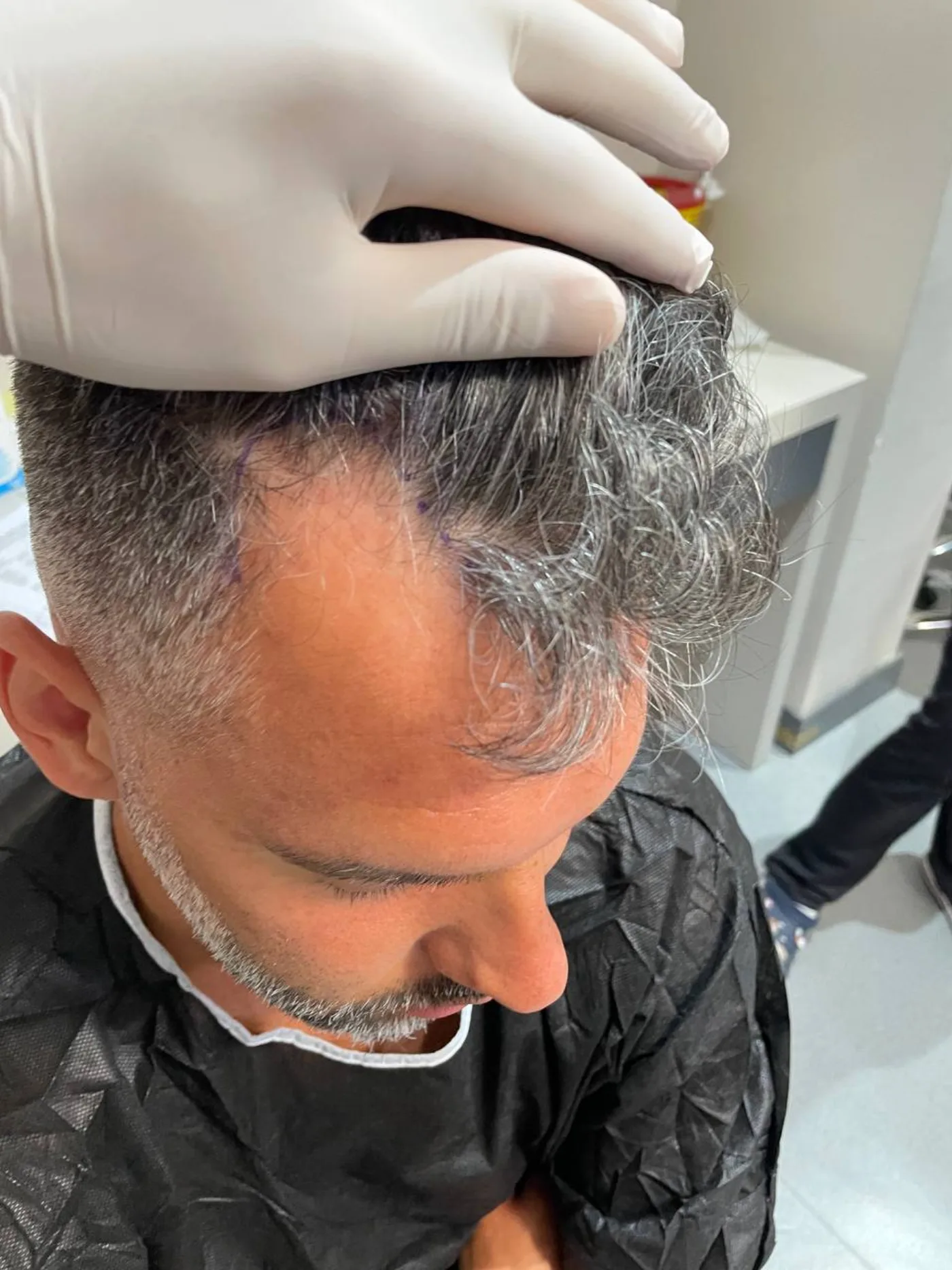
Grafts are extracted from beneath existing hair that's left long enough to cover the donor area. No visible sign anything was done — ideal for someone who works in front of people and can't disappear for two weeks.
Leave looking the way you walked in.
- Duration
- 6–9 hours
- Anesthesia
- Local
- Graft range
- 1,000 – 2,500
- Visible recovery
- 3–5 days
- First growth
- Month 3–4
- Final result
- Month 12–18
What it actually is
The unshaven technique extracts through the curtain of existing hair. The surgeon parts the donor area, removes the grafts and lets the surrounding hair fall back over the extraction sites. Nobody sees a thing.
It is a genuinely harder procedure. Visibility drops, extraction slows and the graft yield per hour falls. That's why the graft ceiling is lower and the price per graft is higher — the honest description of this procedure is that it's a trade-off, not a free upgrade.
It's the right answer for a specific person: someone with a visible job who can take a long weekend but not two weeks off, and who needs a moderate number of grafts rather than full-scalp coverage.
Who it suits
- Public-facing jobs where a shaved head would need explaining
- Moderate coverage needs of roughly 1,000–2,500 grafts
- Existing donor hair long enough to hide the extraction sites
- Willingness to pay more per graft for discretion
When we say no
- Large coverage needs — the graft ceiling is real
- Very short haircuts that leave nothing to hide behind
- Cost-driven decisions; the shaved approach means more grafts for your money
These are general indications, not a diagnosis. Whether this procedure is right for you is decided by an examination, not by a website.
Step by step
What happens,
in order.
- 01
Suitability check
Donor hair length and density are assessed — not every scalp can hide the extraction.
- 02
Design
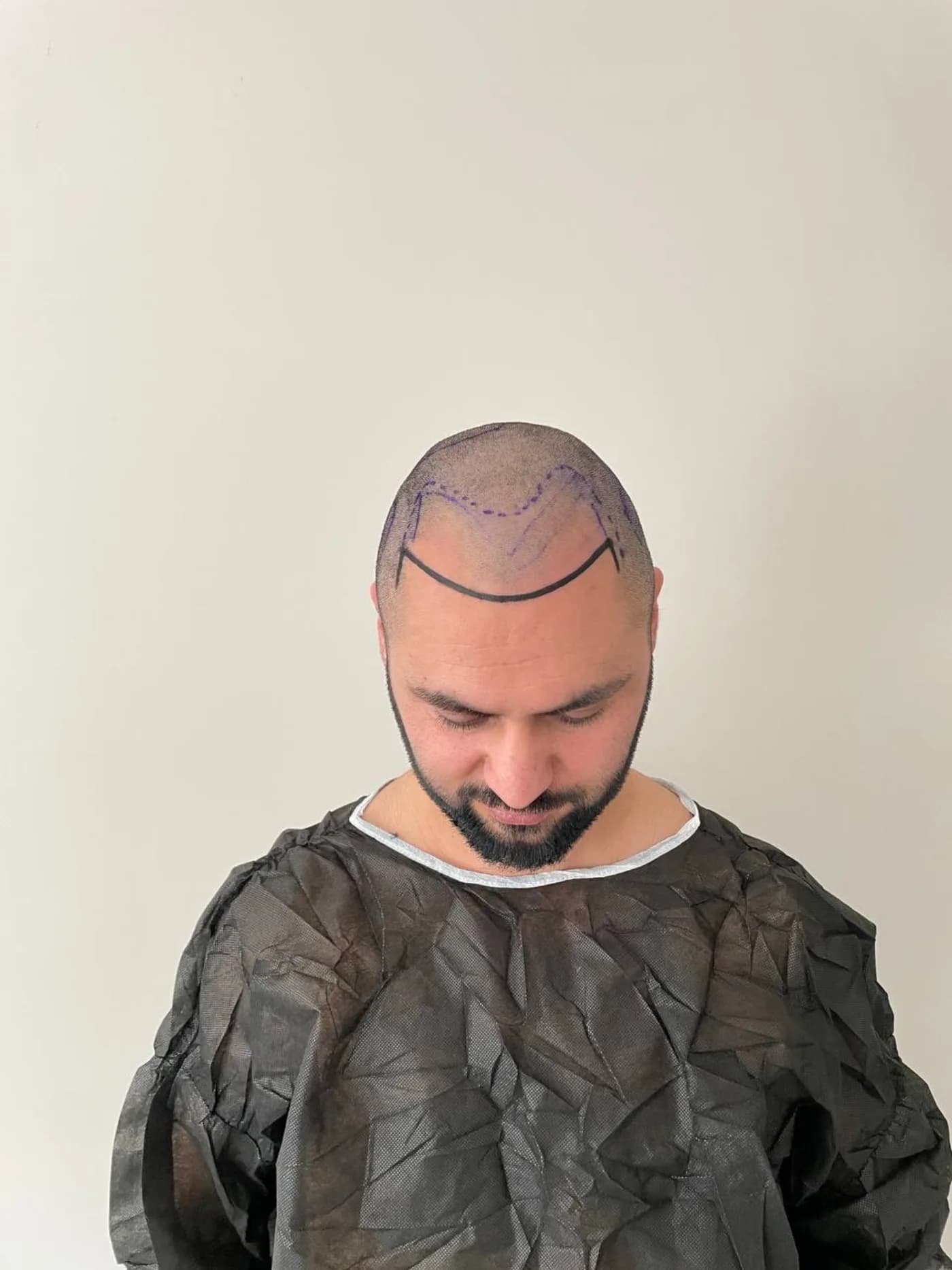
The hairline is drawn with your hair combed the way you normally wear it.
- 03
Sectioned extraction
The donor area is worked in parted sections; surrounding hair falls back over each one.
- 04
Placement
A DHI implanter is used between existing hairs to avoid damaging them.
- 05
Leave unnoticed
You leave with your hair combed over the treated areas.
- 06
First wash
At the clinic the day after surgery, with a technique adapted to unshaven healing.
What 'unshaven' actually means in practice
There isn't a single procedure, there's a spectrum. In a fully unshaven case nothing is cut. More commonly, a small donor strip is shaved and covered by the hair above it; it becomes invisible within days and makes extraction far more controllable. Partial approaches like this are usually the right compromise between discretion and graft count.
The constraint is arithmetic. Extraction requires seeing the exit angle of each follicle, and long hair covers it. That's why unshaven cases move more slowly, cost more per graft and top out at lower numbers than shaved work. Someone promising four thousand fully unshaven grafts in one day isn't describing a surgical plan — they're describing a sales position.
Who this is really for
The typical candidate isn't vain — they're working. A patient who can't be away from a visible job for two weeks, or who doesn't want to explain a shaved head at a wedding three weeks later, has a legitimate reason to accept a smaller session at a higher price.
It's also the default for most women, whose hair loss is diffuse rather than patterned and whose surviving native hair has to be worked around, not removed. In these cases the implanter threads grafts between hairs that must not be damaged; that's slow, precise work, and it's why unshaven procedures are priced the way they are.
Not sure where you stand?
A free assessment gives you a measured graft range and a clear answer on whether surgery is the right move this year.
Get a free assessmentQuestions
Straight answers.
The donor area, no. The recipient area will have small crusts for about a week, and redness if the grafts went into a visibly open area. It's discreet, not invisible.
It takes the surgical team longer per graft and yields fewer grafts per hour. You're paying for time, not for a better follicle.
In experienced hands, there's no meaningful difference. In inexperienced hands, yes — reduced visibility raises the transection rate. Ask how many unshaven cases your surgeon performs each month.
Is Unshaven Transplant the right procedure for you?
Send four answers and let the clinical team tell you — even if the answer is no.